AP Housing Scheme 2026 – How to Check Beneficiary Details Online
Latest Update:
Andhra Pradesh Clears Construction of 2.61 Lakh PMAY (Urban) Houses by 2026
The Andhra Pradesh government has approved a major affordable housing initiative, sanctioning the construction of 2.61 lakh houses under the Pradhan Mantri Awas Yojana (Urban) across the state, with completion targeted by June 2026.
Addressing the media, State Information and Public Relations Minister Kolusu Parthasarathy said the cabinet has agreed to extend a government guarantee to enable the Andhra Pradesh Township and Infrastructure Development Corporation (APTIDC) to raise a term loan of ₹44.51 billion from HUDCO. The funding will be utilised for house construction and supporting infrastructure under the PMAY (Urban) scheme.
According to official estimates, around one lakh applications have been received so far from beneficiaries seeking houses or house sites. Initial scrutiny suggests that nearly 75,000 applicants may be eligible, while surveys indicate that about 25,000 families currently do not own house sites.
The Chief Minister has directed officials to ensure that all pending PMAY houses are completed by October 2026, alongside the rollout of additional housing programmes. The state government has set a long-term goal of providing permanent housing or house sites to all eligible economically weaker families by 2029.
In another key decision, the cabinet approved the cancellation of certain land-pooling plots in the Amaravati capital region due to road realignment, widening, and planning norm violations. The Andhra Pradesh Capital Region Development Authority (APCRDA) has been authorised to cancel such objectionable plots and allot alternative plots through a lottery system, provided the original plots have not been transferred to third parties.
Officials identified 112 plots affected by alignment and planning issues. Beneficiaries of these plots will be offered replacements, while vacant plots arising from cancellations may be used for public purposes.
The cabinet also approved an increase in the maximum land allocation for recognised national and state political parties at constituency headquarters. Eligible parties without their own premises can now receive up to 0.50 acres of government land on lease, up from the earlier limit of 0.30 acres. The annual lease rent has been fixed at ₹1,000 per year, subject to prescribed conditions.
The Andhra Pradesh Government has announced that eligible poor families without houses can apply for homes under the Pradhan Mantri Awas Yojana (PMAY) until November 5, 2026. The decision follows a letter sent by the state government to the Centre, requesting an extension to accommodate more beneficiaries who could not apply earlier.
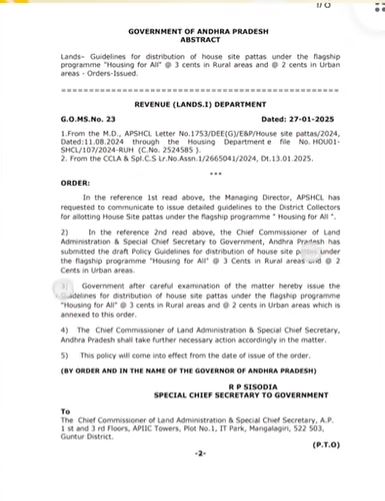
Under the existing G.O. No. 23, applicants from rural areas will be allotted three cents of land, while those from urban areas will receive two cents, along with housing assistance.
Many eligible families had earlier applied for house sites, but due to administrative delays, the process remained pending. Responding to the state’s appeal, the Union Government has permitted new applications for those who remain homeless, particularly the economically weaker sections.
According to government officials, applications must be submitted at the nearest Village or Ward Secretariat or at the Assistant Engineer’s (AE) office of the Housing Department.
Eligibility Criteria
Applicant must be a resident of Andhra Pradesh.
The family should possess a white ration card.
No member of the household should already own a house or house site.
The applicant must be above 18 years of age.
Only families genuinely living in the specified rural or urban areas are eligible.
Ineligible Categories
Government employees (working or retired).
Income-tax payers.
Families already owning houses or plots.
Landowners holding more than 2.5 acres of wet land or 5 acres of dry land.
Required Documents
Aadhaar card
White ration card
Income certificate
Caste certificate
Bank account details (linked with NPCI)
Passport-size photograph
Mobile number
Applicants can obtain and submit the application form at the Housing Department’s AE office. The official website link for downloading the form and further details has been provided by the government.
Authorities have advised all eligible citizens to apply before November 5, emphasizing that this may be the final window to avail benefits under the extended PMAY Rural Housing Survey 2024.
Andhra Pradesh Government Allows Home Construction Permits for Just ₹1
The Andhra Pradesh government has introduced a major relief for poor and middle-class families aspiring to own homes. Under this new initiative, residents can obtain construction permits for houses up to 50 square yards (approximately 450 sq. ft) with G+1 structures for a nominal fee of just ₹1.
Key Highlights of the Scheme:
The permit fee for building small residential units (G+1) is set at ₹1, significantly reducing the financial burden on families.
The initiative is expected to save citizens an estimated ₹6 crore annually in permit fees across the state.
The scheme applies to houses in urban and municipal areas, benefiting families in cities and towns.
A total of 123 municipal wards and various local urban planning zones will implement this provision.
Government Statement: Officials emphasized that the move aligns with the state's commitment to facilitating home ownership for economically weaker sections and middle-income groups. By drastically reducing fees for construction permits, the government aims to accelerate housing development and ease financial constraints for residents.
Impact on Families:
Makes home construction significantly more affordable.
Encourages residents to formalize their properties through proper municipal approvals.
Reduces bureaucratic and financial hurdles in building small houses, particularly in urban areas.
This policy is expected to be a boon for thousands of families across Andhra Pradesh, enabling them to fulfill their dream of owning a home with minimal upfront costs.
Chandrababu's Diwali Gift to AP People: 3 Lakh Houses
Andhra Pradesh Chief Minister N. Chandrababu Naidu has announced a major festive gift for the poor. Speaking in the Assembly during discussions on the "Super Six" welfare schemes, he declared that 3 lakh houses will be completed and handed over to beneficiaries by Diwali. He also promised that by 2029, every family in the state will own a house.
In addition, the CM announced that by October 4 evening, financial assistance of ₹15,000 each will be directly credited to 2.9 lakh auto and cab drivers' accounts.
Key Housing Announcements
Diwali 2026: 3 lakh houses to be completed and given to beneficiaries.
Sankranti 2026: Another 2 lakh houses to be handed over.
March 2026 Target: 10 lakh houses to be completed across the state.
By 2029: Every eligible family in AP will have its own house.
Housing Schemes & Support
Houses will be constructed under NTR Housing, TIDCO, and PM Awas Yojana.
The Housing Department has identified nearly 6 lakh families in need of houses.
TIDCO aims to complete 2 lakh houses by Sankranti.
PMAY (Pradhan Mantri Awas Yojana) has a target of 5 lakh houses.
Beneficiaries from weaker sections will receive additional financial support:
₹50,000 for SC & BC families
₹75,000 for ST families
The government has also made approvals easier:
One-rupee permits for houses up to 50 sq. meters in urban areas.
Relaxations in setbacks and balconies for small constructions.
Welfare Commitments
During a pension distribution program at Datti village in Vizianagaram, Chandrababu reiterated:
"I will work for the poor till my last breath."
AP leads the country in pension distribution.
Over 1 crore women have benefitted from free bus travel under the 'Stree Shakti' scheme.
The government is committed to transparent, welfare-driven governance.
The AP government is determined to ensure rapid housing development for the poor and to make home ownership a reality for every family by 2029. Diwali 2026 will see 3 lakh families entering their new homes, marking a major milestone in the state's housing mission.
The Andhra Pradesh government has launched the AP Housing for All Scheme 2026 to provide free house sites and financial assistance to eligible families across the state. This initiative ensures that economically weaker sections and middle-income families can build their own homes with minimal financial burden.
Key Benefits of the Scheme
Free House Site: Eligible families receive a house site in their name:
Rural areas: 3 cents of land
Urban areas: 2 cents of land
Financial Assistance: In rural areas, funds are disbursed in installments directly into the beneficiary's bank account to support construction. Urban houses are built through agencies like APTIDCO, ULBs, or other government bodies.
Ownership Rights: Full ownership is granted 10 years after receiving the house site, following the A.P. Assigned Lands (POT) Act, 1977 (Amendment Act No. 6 of 2024). After this period, the property can be sold or transferred.
Construction Timeline: Construction must be completed within 2 years of receiving the house site.
Eligibility Criteria
To qualify for the scheme, applicants must meet the following conditions:
Must have a valid ration card.
Should not own any house site or land anywhere in Andhra Pradesh under previous state or central schemes.
Must meet the landholding limits: total agricultural land ≤ 5 acres, with specific conditions for wet and dry land.
Must have a valid Aadhaar card.
Families who previously received house sites under old schemes but could not construct due to court cases or unsuitable locations may reapply.
How Land Is Acquired
District Collectors prioritize:
Available government lands in all departments and corporations.
Vacant lands in APIIC industrial parks.
Donated lands for housing purposes.
Purchased lands as a last resort if no suitable government land is available.
Revenue departments release funds for land acquisition, layout creation, and other expenses to ensure smooth allotment.
Selection Process
Applications are collected at the village or ward level.
Revenue officers (VRO/RI) verify eligibility.
Temporary eligible and ineligible lists are displayed on local notice boards for public feedback.
Final lists are approved by MROs (rural areas) or Municipal Commissioners (urban areas).
If government land is unavailable locally, nearby land may be allotted under special provisions.
How to Apply
Applicants must approach their local Village/Ward Secretariat or Engineering Assistant with the following documents:
Aadhaar card copy
Ration card copy
Land ownership documents (if applicable)
Declaration that the applicant has not received housing under previous schemes
Bank passbook copy
Caste certificate copy
Income certificate copy
Passport-size photographs
Filled Housing for All application form
Note: Applications cannot be submitted online. The Village/Ward Secretariat staff will verify your documents and process your application.
How to Check Application Status Using Citizen Login
Many applicants want to know whether their name is listed or if a house site has been allotted. This can be checked through the Citizen Login portal:
Visit the AP Housing Portal: vsws.ap.gov.in
Click Login → select Citizen Login.
Enter your registered email ID → receive and enter OTP.
Go to Revenue Department → House Site Application.
Enter your Aadhaar number → click Preview.
Status Messages You May See:
"This applicant is already eligible under Housing Scheme Beneficiary" → You already have a house site allotted.
"Eligible under AP Housing Scheme. You can apply" → You are eligible but don't own a house yet.
Important: New applications cannot be submitted via Citizen Login. For fresh applications, you must contact your Village/Ward Secretariat, Engineering Assistant, or VRO.
Important Points to Remember
Each family can receive only one house site in their lifetime.
Sites are linked to Aadhaar or ration cards to prevent duplication.
Construction must be completed within 2 years of receiving the site.
Applications are verified at multiple levels to ensure transparency and fairness.
This version now includes all the latest Citizen Login instructions, clearly explains eligibility, benefits, land acquisition, and application process in an original and structured format.
Check Your AP Housing Scheme Status - Step by Step
Step 1: Open the Portal
Visit the official AP Housing Portal: vsws.ap.gov.in
Step 2: Login
Click Login
Choose Citizen Login
Step 3: Enter Details
Enter your registered email ID
Check your email for OTP → Enter OTP to log in
Step 4: Navigate to Application
Go to Revenue Department
Select House Site Application
Step 5: Check Your Status
Enter your Aadhaar Number → Click Preview
What You May See:
"This applicant is already eligible under Housing Scheme Beneficiary" → You already have a house site allotted.
"Eligible under AP Housing Scheme. You can apply" → You are eligible but haven't received a house site yet.
Important Notes
New applications cannot be submitted online.
For fresh applications, visit your Village/Ward Secretariat:
Engineering Assistant
Village Revenue Officer (VRO)
Keep your documents ready: Aadhaar, Ration card, Bank Passbook, Caste & Income Certificates, and Passport-size photo.