Thalliki Vandanam Scheme 2025 – Full Details
Thalliki Vandanam Scheme: Check If the Amount Has Been Credited to Your Bank Account
The Government of Andhra Pradesh has begun transferring financial assistance under the Thalliki Vandanam Scheme directly to the bank accounts of eligible beneficiaries. Several mothers have already received credit messages from their banks confirming the transfer.
Under this initiative, financial aid is being extended to mothers of children studying from Class 1 to Class 12 across the state. The government provides ₹13,000 per child annually to support education-related expenses. Additionally, ₹2,000 per student is earmarked for the respective schools to help improve infrastructure and facilities.
Minister Nara Lokesh shared that the benefit amount has been released in proportion to the number of children in each family. For instance, a household with four school-going children has received around ₹60,000, of which ₹52,000 has been credited to the mother’s bank account, while the remaining ₹8,000 goes directly to the schools.
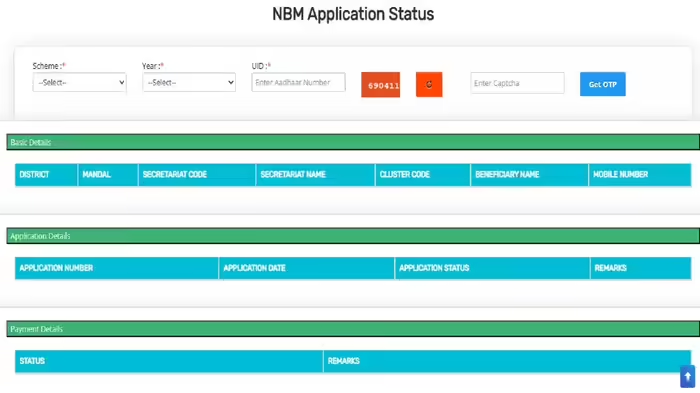
How to Check Thalliki Vandanam Payment Status Online
Beneficiaries can easily verify whether the assistance has been credited by visiting the official website:
👉 gsws-nbm.ap.gov.in/NBM/#!/ApplicationStatusCheckP
Follow these steps:
-
Open the website and go to the Application Status Check section.
-
Select Thalliki Vandanam from the list of schemes.
-
Choose the financial year 2025–2026.
-
Enter your Aadhaar number in the UID field.
-
Type the captcha code displayed on the screen.
-
Click on Get OTP and enter the OTP sent to your registered mobile number.
-
After submitting, the page will display the status of your application and payment.
Check Status via WhatsApp
Beneficiaries can also verify their payment status through WhatsApp Governance (Mana Mitra) by sending a simple message.
-
Send “Hi” to the official WhatsApp number 95523 00009.
-
Select the option for Thalliki Vandanam Status Check.
-
Enter your Aadhaar number when prompted to view your status instantly.
Check Beneficiary Lists at Village and Ward Secretariats
The government has also made the beneficiary lists available at all village and ward secretariats across Andhra Pradesh. Residents can visit their local secretariat to confirm whether their name appears in the list.
If your name is missing or if there are any discrepancies, complaints can be submitted up to June 20. The revised beneficiary list will be prepared between June 21 and June 28, and the final list will be displayed on June 30.
Education is the greatest gift that parents can give to their children. It shapes their future and helps build responsible citizens for the nation. Unfortunately, many children are forced to drop out of school due to poverty. To ensure that no student discontinues education for financial reasons, the Government of Andhra Pradesh has launched the Thalliki Vandanam Scheme.
Under this program, financial assistance of ₹15,000 per student per year is provided. The money is deposited directly into the mother’s bank account. Out of this amount, ₹13,000 goes to the student’s mother and ₹2,000 is allocated for school/college maintenance and development.
This scheme is part of the “Super Six” promises made by the new coalition government in Andhra Pradesh.
Key Features of Thalliki Vandanam Scheme
-
Annual Assistance: ₹15,000 per student (₹13,000 to mother, ₹2,000 for school development).
-
Beneficiaries: Students studying from Class 1 to Class 12 in government or recognized private schools/colleges.
-
Mode of Transfer: Direct transfer to the mother’s bank account (or father/guardian in her absence).
-
Coverage: All eligible children in a family are covered, not just one.
-
Objective: To reduce school dropouts and support education for poor children.
Eligibility Criteria
To apply under Thalliki Vandanam, the following conditions must be met:
-
The student must be a resident of Andhra Pradesh.
-
The student should be studying in Class 1 to 12 in a government or government-recognized private school/college.
-
The student must have at least 75% attendance.
-
The family’s annual income must be less than ₹2 lakh.
-
The mother should have a valid bank account linked with Aadhaar and NPCI.
-
Students belonging to families of government employees, MPs, MLAs, or MLCs are not eligible.
Required Documents
-
Aadhaar card of mother and student
-
Mother’s bank account details (with Aadhaar linking)
-
School/college certificate or admission proof
-
Income certificate
-
Address proof
-
Attendance record (minimum 75%)
-
Passport size photographs
Application Process
Currently, there is no separate online application process for this scheme. The government collects student data through schools and welfare volunteers.
-
Parents can verify and update their details at the school or local Sachivalayam (village/ward secretariat).
-
Beneficiaries can check application status on the official portal:
👉 GSWS NBM Website
Difference Between Amma Vodi and Thalliki Vandanam
| Feature | Amma Vodi (Previous Govt.) | Thalliki Vandanam (Present Govt.) |
|---|---|---|
| Launched by | YSRCP Government | TDP + Jana Sena + BJP Coalition |
| Beneficiaries per family | Only 1 student per family | All eligible students in the family |
| Annual Assistance | ₹15,000 (₹13,000 to mother, ₹2,000 to school) | ₹15,000 (₹13,000 to mother, ₹2,000 to school) |
| Mandatory Requirement | White Ration Card | Economically weaker families (no white card condition) |
| Objective | Prevent school dropouts | Financial aid for continued education |
Implementation in 2025
-
Scheme launched on 12th June 2025, coinciding with the government’s 1-year completion.
-
67.27 lakh students benefited, compared to 42.61 lakh under Amma Vodi earlier.
-
Total expenditure: ₹10,091 crore, out of which ₹1,346 crore allocated for school development.
-
Additional financial burden: ₹5,540 crore due to higher coverage.
How to Check Beneficiary Status
-
Visit the official portal: GSWS NBM Website
-
Select Application Status Check.
-
Enter Aadhaar number and captcha.
-
Verify with OTP sent to registered mobile number.
-
Beneficiary details will appear on the screen.
Frequently Asked Questions (FAQs)
1. Is the scheme only for government school students?
No. Students in recognized private schools/colleges are also eligible if they meet the income and attendance conditions.
2. How many children per family can get the benefit?
All children studying from Class 1 to 12 are eligible. Unlike Amma Vodi, there is no restriction of only one student per family.
3. What happens if the mother is not alive?
The amount will be deposited in the father’s or guardian’s bank account. For orphans, the District Collector will arrange the transfer.
4. Why is the full ₹15,000 not credited to the mother’s account?
Because ₹2,000 is earmarked for school/college maintenance and development, only ₹13,000 goes directly to the mother.
5. What if the money is credited to the wrong bank account?
This usually happens when the Aadhaar number is linked to another active account. Beneficiaries must ensure NPCI Aadhaar seeding in the correct account.
The Thalliki Vandanam Scheme is a major welfare initiative by the Andhra Pradesh government. By providing ₹15,000 per year for every eligible child, the scheme reduces the financial burden on poor families and encourages continuous education. Unlike the previous Amma Vodi scheme, this program benefits all school-going children in a family, making it broader and more impactful.