Thalliki Vandanam Scheme 2026 – Full Details
The Thalliki Vandanam Scheme is a flagship education welfare program launched by the Government of Andhra Pradesh to support school-going children from economically weaker families.
Under this scheme, eligible students studying from Class 1 to Class 12 receive ₹15,000 per year per child, credited through Direct Benefit Transfer (DBT) into the mother’s Aadhaar-linked bank account.
For the academic year 2025–26, over 67.27 lakh students have been identified as beneficiaries, making it one of the largest state-funded education support programs in India.
Scheme Highlights
-
₹15,000 financial assistance per child per year
-
₹13,000 credited to mother’s bank account
-
₹2,000 allocated for school maintenance
-
Applicable from Class 1 to Intermediate (12th)
-
Covers Government, Aided, Private Unaided & Residential schools
-
Direct DBT transfer via Aadhaar seeding
-
Total Budget Approved: ₹10,090.74 Crores
-
Beneficiaries Identified: 67,27,164 students
-
Mothers/Guardians Covered: 42+ lakh
How Much Amount Will You Receive?
| Component | Amount |
|---|---|
| Total Assistance | ₹15,000 per child |
| Amount Credited to Mother | ₹13,000 |
| School Maintenance Allocation | ₹2,000 |
| Mode of Transfer | DBT (Aadhaar-linked account) |
If a family has 3 eligible children, the total benefit will be ₹45,000 (₹39,000 credited to mother and ₹6,000 to schools).
Why ₹2,000 Is Deducted?
The ₹2,000 per student is not deducted as a penalty. It is earmarked for:
-
School sanitation
-
Toilet maintenance
-
Drinking water facilities
-
Infrastructure improvement
-
Hygiene & basic amenities
This ensures better learning conditions in schools across Andhra Pradesh.
Thalliki Vandanam Eligibility Criteria
To receive the benefit, families must meet the following conditions:
Income Limits
-
Rural families – Monthly income below ₹10,000
-
Urban families – Monthly income below ₹12,000
Mandatory Household Conditions
-
At least one family member must hold a valid Rice Card
-
Land holding:
-
Wet land ≤ 3 acres
-
Dry land ≤ 10 acres
-
Total land ≤ 10 acres
-
-
Electricity consumption must be below 300 units per month
-
House size must be below 1000 sq. ft.
-
Private four-wheeler owners are not eligible (Taxi/Auto/Tractor allowed)
-
Families of government employees and income tax payers are not eligible (Sanitation workers exempted)
Student Eligibility Rules
-
Must study in Class 1 to 12
-
School must be Government or recognized private institution
-
Minimum 75% attendance required
-
ITI, Polytechnic, and RGUKT students are not eligible
Official Government Orders – GO 26 & GO 27
GO 26 – Implementation Guidelines
-
Eligibility verification rules
-
Aadhaar authentication process
-
Data validation mechanism
-
Attendance monitoring
-
DBT release conditions
GO 27 – Budget Approval
-
Total sanctioned budget: ₹10,090.74 Crores
-
Approved beneficiaries: 67,27,164 students
-
Mothers/Guardians covered: 42,69,459
These Government Orders provide the legal and administrative framework for scheme implementation in 2025–26.
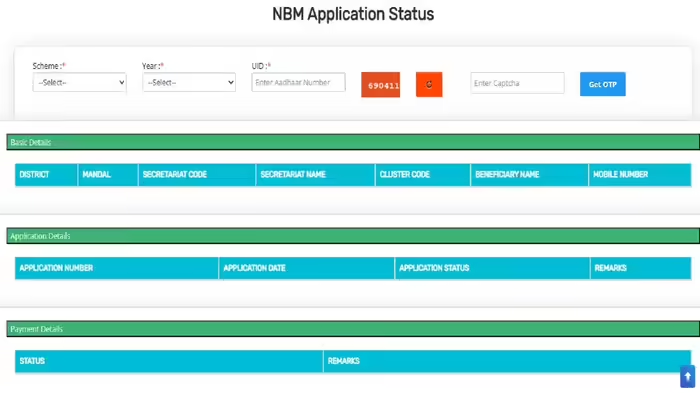
Thalliki Vandanam Status Check – Online Process
Parents can check eligibility status and payment confirmation online through the official portal:
Steps to Check Status
-
Visit the official NBM portal
-
Select “Application Status Check”
-
Choose Thalliki Vandanam scheme
-
Select Academic Year 2025–26
-
Enter Student Aadhaar number
-
Verify using OTP
-
View eligibility and DBT payment details
Status Check via WhatsApp (Mana Mitra)
Beneficiaries can also check through WhatsApp Governance:
-
Send “Hi” to 95523 00009
-
Select Thalliki Vandanam Status option
-
Enter Aadhaar number
-
Receive instant eligibility and payment confirmation
Where Will the Amount Be Credited?
Priority order for DBT transfer:
-
Mother’s Aadhaar-linked bank account
-
Father’s account (if mother unavailable)
-
Guardian’s account
-
Orphan students – Under District Collector supervision
For RTE students in private schools, approved fees are paid directly to the school, and the balance is credited to the beneficiary account.
What If Status Shows “Ineligible”?
If your application shows “Ineligible,” you can raise grievances through:
-
Village/Ward Secretariat
-
NBM online grievance portal
Issue-Based Escalation
-
Vehicle issue → DTO verification
-
Income issue → VRO → MRO → RDO → Joint Collector
-
Other discrepancies → Concerned department validation
Beneficiary lists are displayed at village and ward secretariats. Corrections can be submitted within the notified deadline.
Thalliki Vandanam vs Amma Vodi – Key Difference
| Feature | Amma Vodi | Thalliki Vandanam |
|---|---|---|
| Students Covered | Only 1 per family | All eligible children |
| Assistance | ₹15,000 | ₹15,000 |
| School Allocation | ₹2,000 | ₹2,000 |
| Income Conditions | White Ration Card based | Expanded economic criteria |
| Coverage in 2026 | ~42 lakh | 67+ lakh |
Thalliki Vandanam significantly increases coverage compared to the earlier Amma Vodi scheme.
Why Thalliki Vandanam Is Important
-
Reduces financial burden on poor families
-
Encourages regular attendance
-
Promotes educational continuity
-
Strengthens women’s financial empowerment
-
Transparent Aadhaar-based DBT system
It is currently one of the largest education support schemes implemented by the Andhra Pradesh government.
Frequently Asked Questions (FAQs)
1. Is the scheme available for private school students?
Yes, recognized private school students from Class 1–12 are eligible.
2. How many children per family can receive benefits?
All eligible children in the family are covered.
3. Why did I receive only ₹13,000?
₹2,000 is allocated to the school for infrastructure and maintenance.
4. What if Aadhaar is linked to the wrong bank account?
You must update NPCI Aadhaar seeding at your bank.
5. When will the 2026 payment be credited?
Payments are released as per government schedule after verification and beneficiary approval.
The Thalliki Vandanam Scheme 2025–26 provides ₹15,000 per child annually to ensure that no student in Andhra Pradesh drops out due to financial hardship. With expanded coverage, structured eligibility verification, and transparent DBT transfer, the scheme has become a major pillar of educational welfare in the state.
For latest updates on beneficiary list release, payment dates, eligibility corrections, and official notifications, regularly check the NBM portal or your local village/ward secretariat.